Who makes these movie props?

Most movie props are built by anonymous propmakers, part of movie studios prop departments. Except for renowned star car builders such as George Barris, who is known for star cars such as the original 1966 Batmobile and two of the three versions of K.I.T.T., the Knight Rider car – the Super Pursuit and the convertible (season 4).
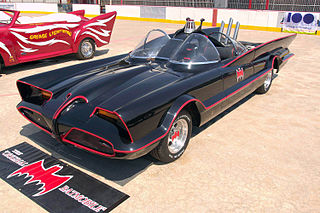
ImageWhen you watch a movie, look for Property Master or Prop Master in the ending credits. The Internet Movie Data Base (iMDB) is also of great interest to find the names of prop makers for your favorite movie or TV show.

Prop departments also subcontract some of the work to independent builders, working on tight deadlines. They grab whatever they can find. This is how some LED panels I made, which were intended for a Knight Rider KITT replica, ended up being used in a console in The Cape (1996-1997 TV series) and some others in Seaquest.

LED clapperboards

In this post, I want to write not about a prop, but rather about an interesting piece of equipment used on sets: the clapperboard.

The clapperboard is the black slate seen at the beginning of a scene, with a clapper on top. It is often seen in the bloopers bonus section of a DVD movie. In addition to its obvious usage to identify scenes and takes, the clapping sound is used as a clue to synchronize audio tracks with video.

In the very beginning of cinema, the clapper and the slate were two separate devices. Then someone had the great idea to put the two devices together so that it could be operated by a single person.

Image

Decades later, the clapperboard got an overhaul by adding an LED display. As can be seen in Matthew L. Davies US patent number 6831729, the electronic version does more than just displaying time on a red digital readout. The digital clapperboard has microprocessors and communication ports, sending sync signals. Therefore the clapper on a digital slate is no longer needed. Some models do have a clapper for nostalgia and tradition.

LED usage in props

LEDs can be used as indicators or for illumination. In TV and movie props, LEDs are almost exclusively used as indicators, rather than for illumination. This is because back at the time when it was cool to use LEDs, their brightness was not enough for illumination. Only in the recent years have LEDs become widely available for illumination.

An advantage of LED over incandescent is their power requirement. LEDs require much less power and are therefore more convenient for portable, battery powered applications, such as hand help props. It is interesting to note that it did not take long for LEDs to be replaced by another technology in consumer, portable electronics, and for the same reasons which saw LEDs enter this field. This other technology is liquid crystal displays (LCD), the dull, grey displays which made funny patterns when you pressed on them. Requiring even less power than LEDs to operate, they quickly took over LEDs in digital watches and calculators.

Michael Knight COMLINK watch, which he used to communicate and control KITT remotely, was using an LCD screen. That COMLINK watch was in fact an LCD AM radio on which a custom faceplate was added.

For many years, the only way to add color and some light to LCDs was to add LEDs behind the LCD. Still that did not have the appeal of LEDs.

Today, about 30 years later, Apple is said to be working on a new watch with a bright, appealing color display.

What is a movie prop?

Maybe I got ahead of myself here and overlooked a very important definition. What is a movie prop?

A movie prop is an accessory used or touched by an actor on the set. The term is short for “property” and comes from “theatrical property”. This dates back to a time when actors would supply their own costumes and it was necessary to differentiate these costumes and accessories from theatrical company property.

Examples of early props include hand held masks and weapons. Usage of the term naturally evolved to include television, movie and digital media productions.

What differentiates a prop from set decoration is whether the item contributes to the story in a significant manner.

In a production, the person in charge of procuring or fabricating a prop is called Property Master or Prop Master. Large productions have Property Masters and Assistant Property Masters as well.

The person responsible for the placement and maintenance of props on a set has the title Property Assistant or Prop Assistant.

Someone building props, either as an employee of a production company or hired as a subcontractor, is often called a Prop Maker or Propmaker.

What is a HERO prop?

Props are usually made in several versions, with different intended uses. For collectors and enthusiasts, the most sought after version is the HERO prop, which is used by the lead star. The hero prop is the most detailed version, being used for close-up shots.

There are background props, typically used by second role actors and extras. Background props are not as detailed as the hero prop.

There are also stunt props, which can be a rubber version of a hard prop for the safety of actors. Stunt props can also be a much less detailed version of the hero prop which will be set on fire, blown up, or literally, as in the case of K.I.T.T., the Knight Rider car, used for stunts.

Hero props are the best references for study when considering building a replica of your favorite prop.

For the most popular movies and TV shows, studios put on display the props in promotional tours and at various locations, such as theme parks and museums. They can also be seen in backlot tours. Although sometimes introduced as being hero props, they are not all actual “heroes”. For having been mandated by movie studios to build replicas of some props, I can tell. Keep this in mind when looking for reference material about a specific prop.

A brief history of LEDs

LED stands for Light Emitting Diode.

An LED is a semiconductor device. In more technical terms, it is a PN junction diode which emits light when an electrical current flows across.

Although the LED was invented in 1962, it is not until 1968 that it has been commercially available.  The first visible LED was only available in red. Yellow, orange and green followed in the 70s but did not catch on on popularity until years later.

In the 70s, we saw red LED displays appear on household devices such as watches and calculators.

The original package for LEDs was a round casing with a dome shaped top, in either 5mm or 3mm diameter. These packages, still widely in use today, are called T1-3/4 (5mm) and T1 (3mm). The dome shaped top acts as a magnifier lens and the material as a diffuser.

Multi LED packages appeared at the end of the 70s, arranged in bar graphs in which individual LEDs were visible or light bars in which several LEDs were placed in a larger, diffused package.

It took more than two decades to see other LED colors, with the first blue LED in 1994. Research and development of the blue LED was motivated in part by its possible application in television displays, as it would allow covering the whole visible spectrum by combining blue with red and green.

White LEDs followed shortly after blue, but not by combining all colors. Instead, white has been achieved by an application of phosphor coating on blue LEDs.

The industry has come a long way since the original red LED. I still remember when the first LED calculator entered our house in 1975.